How Many Calls Does a Dental Practice Miss?
Most dental practices do not know how many valuable patient calls they miss. The obvious missed calls are easy to see. The real problem is the invisible ones: the patients who ring, wait, get no answer, and quietly call another practice.
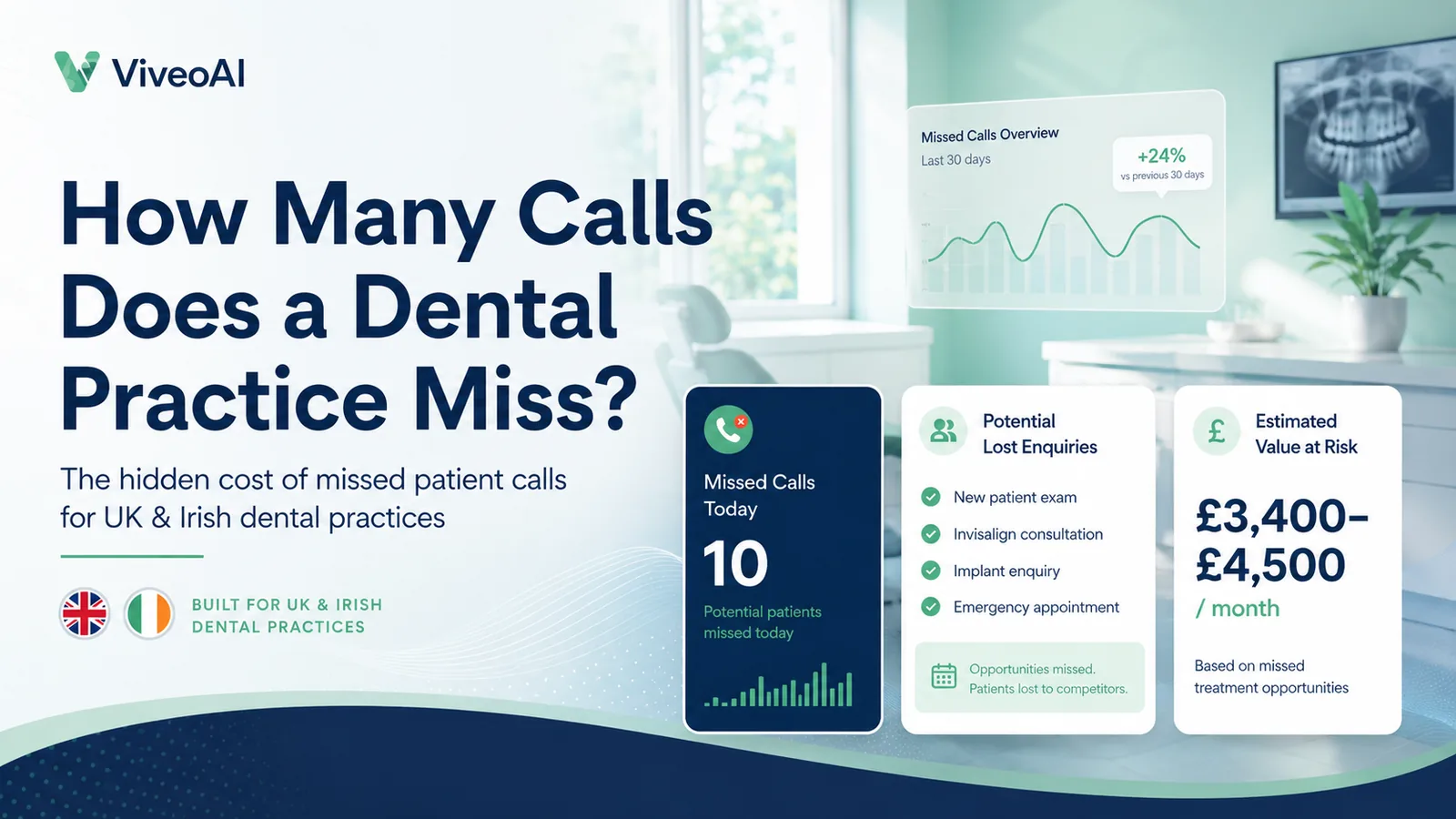
This is especially important for high-value enquiries such as:
- New patient exams
- Emergency appointments
- Invisalign consultations
- Implant enquiries
- Whitening enquiries
- Hygiene appointments
- Private treatment enquiries
The hidden problem with missed dental calls
A missed call is not just an unanswered phone. It may be:
- A new patient trying to register
- A nervous patient finally building up courage to book
- A private patient looking for Invisalign or implants
- Someone in pain looking for an emergency appointment
- A patient who needs reassurance before committing
- A family trying to book multiple appointments
Many of these callers will not leave a voicemail. They will simply search again, call another practice, or use the first provider who answers.
Why voicemails do not tell the full story
Studies and industry surveys consistently suggest that most patients who can't get through to a healthcare practice never leave a voicemail. Many simply hang up and try the next practice on the list.
That means the voicemails your team listens to each morning represent only a small fraction of the patients who tried to reach you. The rest disappear silently - no missed call record, no message, no second chance.
For dental practices, where a single new patient or high-value treatment plan can be worth thousands of pounds in lifetime value, this silent leakage adds up quickly.
A simple way to estimate what missed calls cost you
You don't need a complex audit to get a useful estimate. Even rough numbers reveal the scale of the opportunity:
Worked example
- 10 missed calls per day across reception
- Assume 3 are genuine new patient or treatment enquiries
- Average treatment value of £400
- Even a 25% conversion rate on those enquiries
That's 3 × £400 × 25% = £300 of potential treatment value lost every working day - roughly £6,000+ per month before you factor in lifetime value, family referrals or repeat visits.
Adjust the inputs for your own practice and the picture rarely improves. For high-value treatments like implants or full Invisalign cases, a single missed enquiry can be worth more than a month's lost calls.
When dental practices miss the most calls
Missed calls are rarely random. They cluster predictably around moments when reception is under pressure:
- First thing in the morning, when overnight enquiries land at the same time as walk-ins
- Lunchtime, when reception cover is reduced
- End of day, when patients call after their own working hours
- Evenings, weekends and bank holidays, when the practice is closed
- Busy emergency days, when one complex call ties up the line
These are exactly the moments when patients are most motivated to book - and most likely to move on if no one picks up.
Why this is getting worse, not better
Patient expectations have shifted. People expect to reach a practice quickly, get a clear answer, and feel looked after on the first call. At the same time:
- Reception teams are handling more channels than ever - phone, email, web forms, messaging
- Recruitment for experienced dental receptionists is harder
- Private treatment marketing is generating more inbound enquiries
- Patients are more willing to switch practices if first contact is poor
The result is a growing gap between the calls coming in and the calls a busy front desk can realistically answer well.
How an AI receptionist helps
An AI receptionist for dental practices is designed to sit alongside your reception team, not replace it. The goal is to stop valuable calls from disappearing when the team is busy, unavailable, or out of hours.
For calls routed to ViveoAI, every caller gets answered. The AI understands the reason for the call, captures the patient's details, and either books, escalates, or schedules a callback according to your agreed practice rules.
Your team then gets a clear record of what happened through ViveoInsights, so reception can focus on the patients who genuinely need a human callback - rather than spending the morning listening to voicemails.
Practices comparing options often ask how this differs from a traditional answering service. We've broken the differences down in detail in AI receptionist vs call answering service.
To see exactly what's included and how setup works, take a look at the full ViveoAI features overview, or review pricing on the ViveoAI pricing page.
ViveoAI is designed to support reception teams rather than replace them - and to reduce missed enquiries without asking practices to overhaul how they work.
The bottom line
Most dental practices underestimate how many calls they miss, because the worst losses never leave a trace. Voicemail counts, call logs and "the team handled it fine" anecdotes all paint a more optimistic picture than reality.
Once you start measuring genuine inbound demand against actual answered calls, the gap is almost always larger than expected - and it's almost always made up of exactly the patients you most wanted to win.
Stop Letting Valuable Patient Calls Slip Away
ViveoAI helps dental practices answer more calls, capture more enquiries, support out-of-hours patients and reduce pressure on reception teams. For calls routed to ViveoAI, every caller gets answered - and your team gets a clear record of what happened through ViveoInsights.
Also useful: read the ViveoAI FAQ for answers to common practice questions.